72-hour emergency kit checklist
The EU now asks every household to be able to manage on its own for at least 72 hours in a crisis. This checklist shows you in one evening what you already have at home, and what is missing.
The new European standard
When a crisis hits, emergency services cannot be everywhere at once. That is why European governments now ask households to cover their own basic needs for the first days.
Sources: European Commission, Preparedness Union Strategy (March 2025) and the population preparedness guidelines (November 2026).
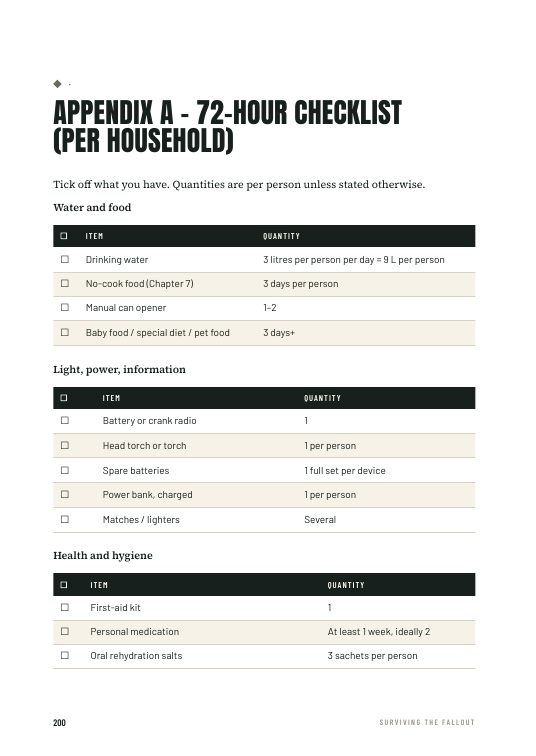
Everything for 72 hours, with quantities
Most lists tell you what to pack. This one also tells you how much: per person, per device, per household. Here is the full list; the PDF has it with tick boxes, ready to print.
Water and food
- Drinking water3 L per person per day = 9 L
- No-cook food3 days per person
- Manual can opener1–2
- Baby food, special diet, pet food3 days or more
Light, power, information
- Battery or crank radio1
- Head torch or torch1 per person
- Spare batteries1 set per device
- Power bank, charged1 per person
- Matches or lightersseveral
Health and hygiene
- First-aid kit1
- Personal medication1 week, ideally 2
- Oral rehydration salts3 sachets pp
- Toilet kit: bucket, bags, cat litter1
- Toilet paper, wipes, sanitiser3 days or more
Warmth
- Warm blankets or sleeping bags1 per person
- Emergency blankets1 per person
- Warm clothing, hat, gloves1 set per person
Documents and money
- Copies of documents, waterproof1
- Cash in small notese.g. €70 adult, €30 child
- Emergency information card1
- Phone numbers on paper1
Safety
- Smoke and CO detectorsevery floor
- Fire blanket and extinguisher1 each
- Whistle1 per person
- Multi-tool, duct tape, bin bags1 set
How ready are you?
One minute. Tick what is already in your home and kept in a fixed place.
Sorted in one evening
Enter your email
You get an email straight away to confirm your address, so we know it is really yours.
Download and print
The checklist is a 3-page PDF. Stick it inside a kitchen cupboard door.
Tick off, top up
Walk through your home and tick off what you have. Whatever is missing goes on your next shopping list.
Good to know
What should be in a 72-hour emergency kit?
Water (3 litres per person per day), food you can eat without cooking, a battery or crank radio, torches and spare batteries, a power bank, a first-aid kit and your own medication, warm blankets, cash, copies of important documents and a toilet kit. The full list with quantities is on this page.
How much water do you need for 72 hours?
Plan on 3 litres per person per day, so 9 litres per person for three days. That covers drinking and some cooking. Pets need extra.
How much cash should I keep at home?
A common guideline is around €70 per adult and €30 per child for the first 72 hours, ideally in small notes. In a power cut, cash machines and card terminals often stop working.
Do I need to buy a ready-made emergency kit?
No. You probably have most of the items at home already. Building your own is usually cheaper and you know exactly what you have. The checklist helps you buy only what is really missing.
Is the checklist really free?
Yes. You pay nothing and you are not tied to anything. Afterwards you get an occasional short email with a practical tip, and you can unsubscribe with one click.
What happens to my email address?
We only use it to send you the checklist and our tips. We never sell or share it. Read more in the privacy policy.
The complete emergency guide
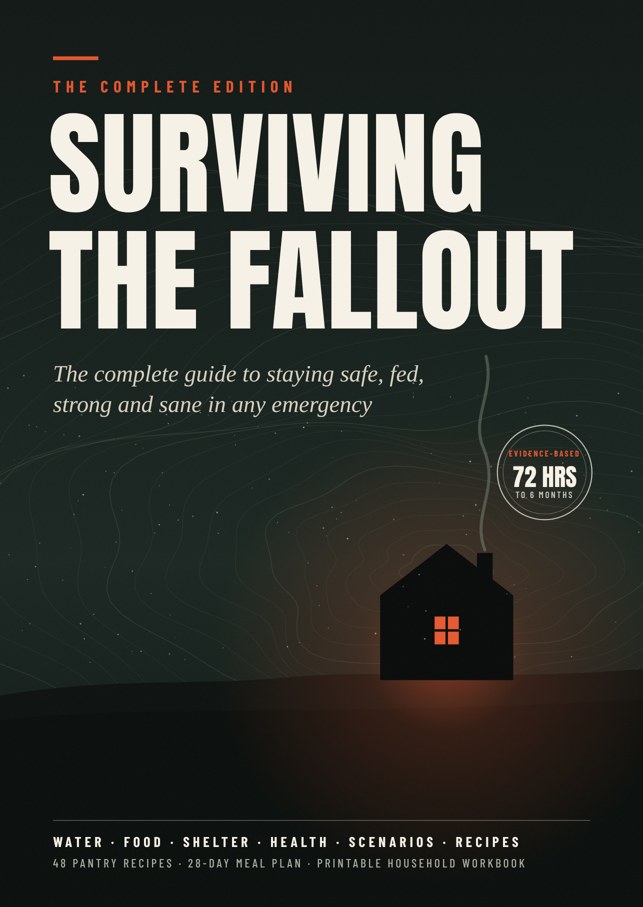
The checklist is Appendix A of Surviving the Fallout: a complete guide to water, food, warmth, health and 14 scenarios, with 48 pantry recipes. Start with the checklist; the book can wait.
See the book →Start tonight
You cannot control the news. You can control how ready you are, for yourself, your family and your neighbours.